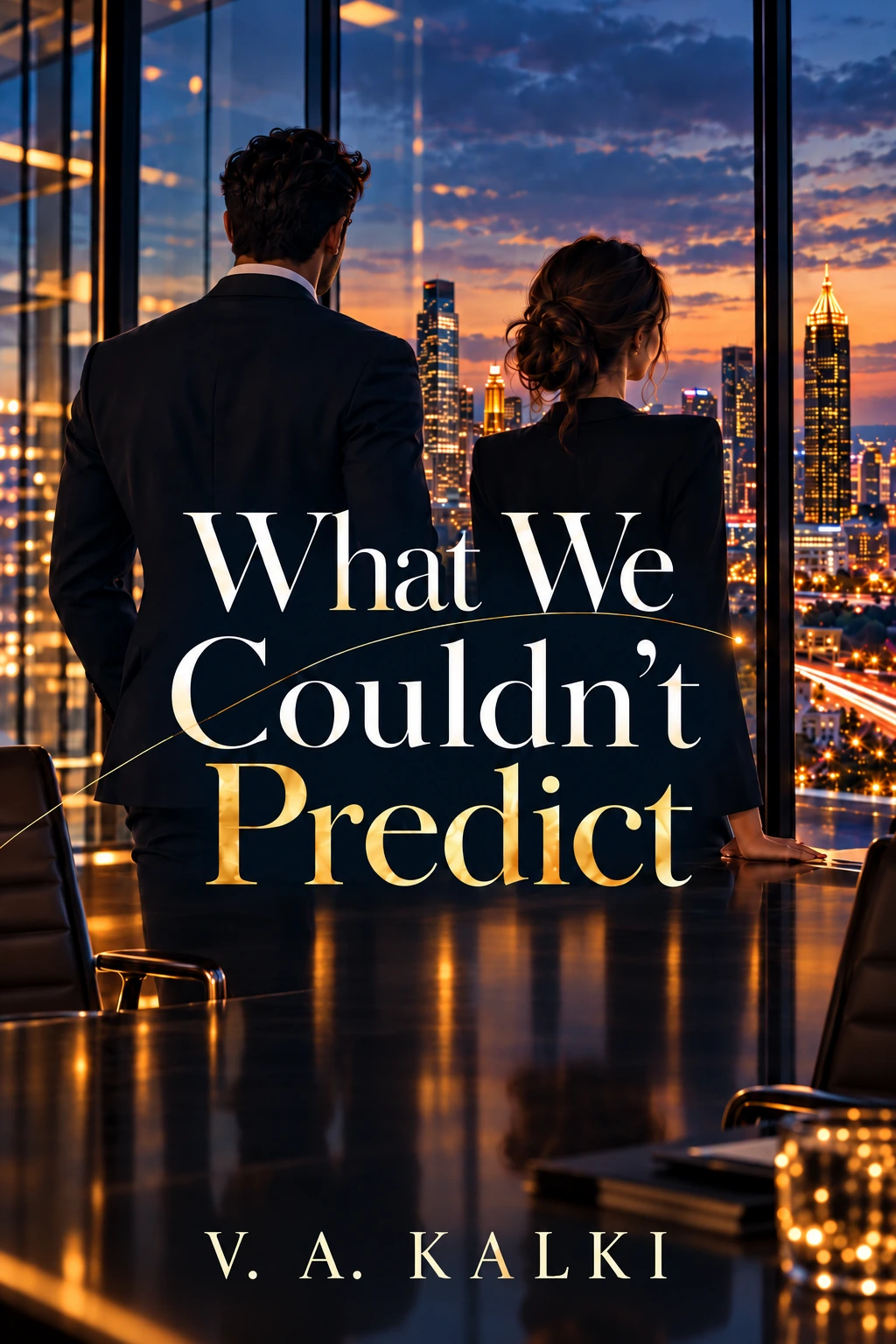
Read the complete first chapter · Back to book details
Chapter 1 – Boardroom
Dev — Monday, 8:47 a.m.
They put me in the anteroom.
Not the boardroom itself — not yet. The smaller room off to the side, glass on three sides, the kind of space built for two people to have a conversation nobody else in the company gets to hear. I know this room. I have never once had to wait in it before.
There's coffee on the sideboard, the good kind, the kind reserved for partners and for men about to be told bad news gently. Nobody's offered me a cup. I don't think anyone in the building has decided yet which of those two things I currently am.
Through the glass I can see fragments of the boardroom — a sleeve, a shoulder, the corner of the walnut table — but not enough to read the room. I've spent years learning to read rooms for a living. Voices carry through the wall in pieces, flattened by the glass into something I can't quite parse. A name I don't catch. A long stretch of quiet that's somehow worse than the talking. One short laugh that isn't a happy sound.
I reach for my phone out of habit before I remember they asked me to leave it with the assistant outside. I don't even know her name. Cindy isn't at her desk this morning. Nobody's explained that either.
Only six days ago I was the one on the other side of that glass, watching a room assemble itself around Marcus and me like the whole floor existed to be impressed by us. I was the one people waited to be let in and see. I used to sit at that table and think of the door opening as a kind of tribute — proof that whatever was happening inside mattered more than whatever the person on the other side of it was doing with their morning.
It is a specific, humbling kind of vertigo, discovering how fast a room can stop being yours.
I make myself breathe evenly, the way my father taught me before I was old enough to ask why it mattered. Four counts in, hold for four, four counts out. Slower than felt natural, until the room stopped closing in. He never called it anything more formal than just breathe, beta. I only learned the actual word for it years later, in a book, like being handed the name for something I'd already been doing my whole life. Don't rush the exhale. Don't assume the worst before you've finished counting. I get through two cycles before I look at the boardroom door again. Somewhere beyond it, people are deciding how much of my company I get to keep. Sarah hasn't answered either of my calls.
By the time the door finally opens, it's past nine. A paralegal I don't recognize holds it for me without meeting my eyes, which tells me more than anything anyone has said to me all morning.
Inside, the boardroom doesn't look like the room that pulled a hundred million dollars out of the air only a few days ago. It looks like a room built to hold a funeral nobody has agreed to call it by that name yet.
They're already seated. Voss, Cho, and most of the board members. Two men in gray suits I don't recognize — outside counsel, the kind you hire once you've stopped trusting your own to save you. A single manila folder sits squared at the center of the walnut table, closed, its edges lined up with the grain like someone in the room needed one thing to be exact.
Marcus's chair is empty.
Nobody has moved to fill it. Nobody explains why. I don't ask. Some questions you don't ask out loud in a room full of people who are watching to see if you already know the answer.
Sarah's chair is empty too.
I make myself look away before anyone can read my face. If this morning is only about Marcus, there's a version of it I know how to survive. But it isn't.
Somewhere in that folder are the things Sarah did, and the things I let her do, without my ever asking what her own compliance department would call them. I don't know what those decisions will cost her.
Voss doesn't stand when I walk in. He looks at me the way he looked at Marcus the first Tuesday of all this, except there's no reluctance left in it now — nothing held in reserve.
"Sit down, Mehta."
The name lands wrong before I even register why. Eleven years of Dev, dropped without ceremony into something flatter, more procedural — the tone you use on someone whose access you've already revoked. I don't know exactly when that stopped being a formality he skipped and started being one he chose. Probably before I noticed. Everything else this morning has been.
"Walk us through it," he says. "From the beginning."
I don't sit, not yet. I look at the closed folder instead. For one unsteady second I'm fourteen years old again — standing on the near bank of a river in Ahmedabad, watching men in hard hats measure a gap that used to be a bridge, waiting for someone to explain how something built to hold that much weight came apart in an afternoon.
I already know how this version ends. I'm the one who built the model that told me.
What none of them in this room understand yet is that the folder isn't the part I'm dreading. It's everything six days behind it — the part where I have to explain, out loud, exactly which afternoon I first knew, and exactly how long I let it run anyway. I finally sit down.
SIX DAYS EARLIER
The glass-walled boardroom on the fortieth floor of the Aegis tower hung over Atlanta like a command center suspended in the clouds. Forty floors below, the city unrolled itself in neat, obedient rectangles of asphalt and glass, cars crawling along the grid like blood cells through a circuitry diagram. I used to find that comparison poetic. Lately it just felt accurate.
But I wasn't looking at the city. I never did, not really. My eyes always found their way back to the laptop screen in front of me, where lines of telemetry scrolled past faster than any human eye should be able to read — and yet I read them, the way other people read a heartbeat monitor. Steady. Steady. Steady. Everything was fine. Everything was always fine, right up until the moment it wasn't.
Marcus was pacing the length of the custom walnut conference table, his Italian suit catching the morning glare in sharp, expensive flashes. There was a manic, intoxicating energy to him today, the kind I'd only seen a handful of times in the eleven years that I'd known him — the night we signed our first term sheet, the morning the seed round closed, the day we hired our fiftieth engineer. He wasn't just giving a quarterly update. He was about to preside over a coronation. And he knew it. And he wanted everyone in that room to know it too.
I should have been nervous. Any sane person would have been. In a few minutes, I'd be courting a room full of apex predators — hedge fund partners who ate quarterly losses for breakfast, private equity sharks who'd gutted companies twice our size for sport.
But Marcus wasn't nervous. Marcus was hungry.
I watched him glance between the skyline and the display screen, and I could see the gears turning behind his eyes, already counting the hundred million dollars we were about to pull out of this room like magicians pulling silk from a sleeve. Money explained the pitch. It had never fully explained him. Even after years of this, I couldn't isolate what else he was trying to prove. Something underneath it, if you caught it from the wrong angle, looked less like ambition and more like something he felt he was destined for — a life mission that ran deeper than any pitch deck, one I suspected he'd never fully put into words even in his own head.
I smiled without meaning to. It was hard not to get swept up in his gravity. This far in, I still couldn't tell where his conviction ended and mine began. Cindy came in on quiet heels, a glass of hot lemon water balanced in one hand for Marcus, a ceramic cup of double espresso set down beside my laptop without a word — she'd learned my habits faster than I'd learned her last name.
"If you're ready, I'll let them in?" she asked, looking at me.
I looked at Marcus. Something in his jaw tightened, just for a second — the only visible crack in the armor I'd see all morning.
The heavy glass doors clicked open. They filed in — institutional heavyweights I'd shaken hands with a dozen times, men in the kind of suits that cost more than my first car, carrying the particular stillness of people who had made billions betting on corporate blood sport and never once lost sleep over the bodies left behind.
And then there was one face that didn't belong. One face I would have recognized in a blackout, in a stadium, in the dark.
Sarah.
She stepped through the door in a sharp charcoal-gray blazer, dark hair pulled back with a precision that looked effortless and definitely wasn't — the same habit she'd had for as long as I'd known her, except the woman I remembered used to scrape it back in nine seconds flat and never once checked a mirror. This version had a faint warmth running through it, something new, something chosen on a day that had nothing to do with me. And under the blazer, barely visible at her collar, an actual color — not much of one, but seven years ago her whole wardrobe had been camouflage, gray on navy on cream, nothing that would ever out-argue a number on a page.
It was a strange thing to notice in the middle of a hundred-million-dollar pitch. I noticed it anyway. She didn't walk into a room so much as recalibrate it — every head turning a few degrees toward her without quite meaning to. She carried herself like someone who didn't manage capital. She weaponized it.
For one suspended fraction of a second, our eyes met across the length of the walnut table. She gave me a crisp, professional, utterly unreadable smile. I gave her a tight nod back, the kind you give a stranger, the kind that costs nothing and reveals even less.
Well, how about that, I thought, filing the jolt of surprise away the way I filed away anything I didn't have time to feel yet. Meridian sent Sarah.
The only woman at the table. The one person I had spent seven years trying not to think about. It had never occurred to me that she'd walk back into a room I controlled.
The room hummed with the low murmur of expensive small talk, but for a moment the sound dropped away entirely, replaced by a kind of pressure behind my sternum. Seven years. It felt like a different geological era — a different Dev, a different Sarah, a different life before either of us had understood what the other was capable of. And now here we were, trapped in the same glass box forty stories above the ground, with nowhere for either of us to look except at each other or the thing we'd both agreed, wordlessly, not to look at all.
I had designed the presentation for the room I thought I was getting. The first twelve minutes were mine: define the system, establish its boundaries, and walk them through the validation results. Marcus would follow with deployment, growth, and the path to scale globally.
I stood at the head of the table.
"Good morning everyone. I'll begin with the system itself. What it does, what it doesn't, and what seven years of results allow us to say with confidence. Marcus will then take you through the operating plan and our next stage of growth."
I had delivered versions of that opening enough times that the words required almost nothing from me. The first slide appeared.
"Aegis consumes three defined classes of signal: transactional behavior, disclosed financials, and public or licensed data authorized through a company's onboarding agreement. From those inputs, it outputs exactly one thing: a probability. A number between zero and one, attached to a specific named event, inside a specific bounded window."
I advanced to the next slide.
"It can identify the probability that a company's reported numbers do not match its actual cash movement. It cannot tell you why. It cannot tell you what someone is thinking or feeling, and it cannot predict an event that has left no transactional trace. Aegis models companies, markets, and the financial relationships between them."
A short pause, so everyone could understand the full scope of Aegis and, more importantly, what it didn't do.
"It does not model people."
That was the boundary I had built. It modeled companies. It had never once been pointed at a person, because nobody — not Marcus, not our engineers, not the product spec sitting in a locked folder three servers down — had ever asked it to be.
Marcus's version made better copy. Mine was the version that had actually shipped. I advanced to the validation results. I knew every number on the slide. I knew the sample sizes, the confidence intervals, and the three anomalies we had excluded from the headline figure.
For two seconds, I couldn't remember which number I intended to say first.
My eyes found Sarah before I could stop them. She wasn't looking at the display. She was looking at me. I recovered, at least I think I did. Nobody in the room would have called it a pause. But the sequence no longer felt stable. And I had learned a long time ago what happened when I continued running a process after I stopped trusting its output.
"Marcus," I said, setting the stylus beside my laptop. "Would you take everyone through the growth plan now."
His eyes moved from the stylus to me. The hesitation lasted less than a second, followed by, "Of course."
He picked up the stylus and crossed to the display. To everyone else, the transition probably looked planned. It was planned. Just not for another eight minutes. Sarah lowered her eyes to her legal pad and wrote something down.
President and Chief Operating Officer were the titles beneath Marcus's name in the deck. It was accurate, but incomplete. He was the showman. He wore the suit, worked the room, handled the theater of it all — the sweeping hand gestures, the practiced pauses, the eye contact that made billionaires feel like they were the only person in the room.
But the thing humming behind the walls of Aegis, the actual architecture — the neural topology, the predictive engines, the obscene, ungodly quantity of raw data we had vacuumed out of every digital crevice on the planet — that was all me. Every line of it.
It had started as a whiteboard covered in scribbles in a cramped Riverside Drive apartment that smelled permanently of instant noodles, an idea I'd been too broke and too unknown to build alone. I'd brought it to Marcus because he was the only person reckless enough to believe it and ambitious enough to sell it.
We weren't just getting rich. That was the story we told the board, the easy version, the one that fit on a slide. The real story was our AI. Trained on more transactional history than any system I'd personally seen in production, pulled from corners of the economy most of the industry didn't even know to look at. And what we were doing with that reach, if I was being honest with myself in the small hours of the morning, was a little bit frightening: we were trying to prove that human behavior — the whole chaotic, irrational, beautiful mess of it — could be modeled, predicted, and ultimately controlled.
Hacked. Optimized. Perfected.
At scale, I would have clarified, if anyone had asked. Patterns across thousands of corporations — their finances, their executive teams, their lenders, and the countless factors that could determine whether they survived. Never a verdict about one person. That distinction mattered enough that I'd built safeguards around it. It bothered me sometimes how easily Marcus could describe our ambition without mentioning the boundary. It bothered me more how rarely I interrupted him to put it back.
I used to say that sentence out loud with pride. Lately I only said it in my head, and even there it had started to sound less like a mission statement and more like a warning label.
Marcus tapped a stylus against the wall-length display, and cascading rivers of predictive telemetry pulsed to life in brilliant blue and gold, numbers breeding numbers, patterns emerging out of what looked, to anyone without years of training, like pure noise.
"Wall Street has spent a hundred years staring into the rearview mirror," Marcus said, his voice dropping into that smooth, hypnotic register that could make a room forget to breathe. "They call it financial modeling. I call it guesswork with a spreadsheet."
Appreciative laughter rippled around the table. They weren't just listening. They were leaning in.
"What Dev and I built isn't an incremental upgrade." He spread his hands, missionary zeal lighting up his face like a man testifying at his own revival. "We're mapping the core architecture of human decision-making. We can forecast market collapses, corporate fraud, consumer default — weeks before the market even twitches. We're not disrupting forecasting. We're rewriting the rules of capitalism."
I felt the familiar warm glow of validation spreading through my chest, the quiet certainty that I was the architect of something the world hadn't caught up to yet. I let myself have it for exactly three seconds.
Then the first crack in the room's momentum appeared, and — of course — it came from the one man I'd been quietly dreading all week.
Harlan Voss, the board's chairman and one of Aegis's largest early investors, ran one of the oldest, most conservative funds at the table — a man built like a retired boxer who'd made his fortune the boring way, decades of due diligence, zero appetite for hype. He didn't raise his hand. He simply spoke, in the flat, unhurried tone of a man who had never once in his career worried about being interrupted.
"Forgive me, Marcus, but I've sat through a hundred pitches that promised to rewrite capitalism. Most of them rewrote a bankruptcy filing instead." A few uncomfortable chuckles quickly swallowed. "You're telling this room your model can predict corporate fraud before it happens. I want to know what happens when it's wrong. What happens when your engine flags an innocent company, and some fund manager in this room shorts it into the ground based on a probability score he doesn't understand?"
Marcus didn't flinch — he never did, not visibly — but I saw the almost imperceptible tightening at the corner of his mouth, the one only I would recognize after all these years.
"Our false-positive rate is under half a percent, Harlan," Marcus said smoothly. "That's not guesswork. That's precision."
"Half a percent of what sample size, though," said another voice — younger, sharper, a private equity partner named Allen Cho who I knew had a reputation for gutting management teams he didn't trust. "And more to the point — where does the data come from? Because I've read the appendix, Marcus, and 'every digital corner of the globe' is doing a lot of heavy lifting in that sentence. If regulators start asking the same question I'm asking, this isn't a valuation problem. It's an existential one."
The room's temperature dropped by a degree. I felt my pulse do something unpleasant.
Marcus opened his mouth to answer, but it was Sarah who spoke first — quiet, precise, almost gentle, which somehow made it worse.
"I think what my colleagues are circling," she said, folding her hands on the table, "is a simpler question. Not whether your model can predict a company's future. It's whether it should. And what happens when those predictions begin influencing the very outcomes they're supposed to anticipate? When lenders withdraw financing, investors abandon companies, or boards replace executives — not because something has gone wrong, but because your model predicts that it may? All without the company being aware of the prediction, much less having an opportunity to challenge it."
Her hands stayed folded on the table. Nobody moved to fill the quiet that followed.
"I'm not asking that as a hypothetical either." She didn't raise her voice. She didn't need to. "Before I walked in here this morning, I pulled eighteen months of your own model's flagged accounts — the ones that never made it into a slide. Halvorsen Freight. Sixty-one employees. A fraud-probability score north of ninety percent, and nobody at this table ever required to look at why."
I remembered the name. I'd written an apology once, the version Legal actually let go out — three sentences, reviewed by four people, none of them mine anymore by the time it shipped.
"It took their bank four months to unwind a credit freeze your own system triggered, and a full audit afterward proved wrong. Thirty-one of those sixty-one employees don't have their job anymore."
I'd known that number once. I hadn't carried it the way she apparently had.
"Nobody at Aegis was charged with anything for that. Nobody in this room was, either. I'd like to understand, before this fund puts one more dollar behind that number, what's actually supposed to stop it from happening to the next Halvorsen Freight."
Every eye in the room shifted to me. Marcus could sell Aegis. I was the CEO and the chief architect. The design was mine and so was the responsibility. The answer should have been automatic. Instead, the question reached me and nothing came back. The eight minutes I had surrendered to Marcus had bought me no distance at all. I had Sarah's eyes instead, steady and unreadable, and the sudden sick certainty that she hadn't come here for due diligence at all. She had come to find out whether we would tell the truth.
Marcus, mercifully or not, stepped into the silence before it became an answer of its own.
"Sarah raises a fair point, and it's one we take seriously." His voice had shifted register again, softer now, almost pastoral — the tone he used for investor calls when a number came in soft and needed dressing. "Every prediction our engine generates is advisory. A human being makes the final call. We're not replacing judgment. We're augmenting it."
It was, I realized with a small, unpleasant jolt, almost word-for-word the line from our Series B deck. I'd watched him deliver it to a room of nodding heads in San Francisco a year ago, before we'd expanded the training data tenfold, before "advisory" had quietly become a formality baked into workflows that no longer waited for a human to weigh in on anything.
A few heads around the table nodded, satisfied, already reaching for their coffee. They'd gotten the answer they came for — not because it was true, but because it let them stop asking.
Sarah didn't nod.
"That's the version for the deck," she said, evenly, folding her hands again like she had all the time in the world. "I've read the deck. I'm still asking the question I actually asked."
I knew that particular stillness of hers. It was the same look she used to wear arguing a point with a professor twice her age, patient and immovable, waiting for the room to catch up to a question everyone else had already decided to stop asking. I used to find it the most attractive thing about her. Sitting across that table from it now, I understood for the first time that it was also the most dangerous.
For the first time all morning, something flickered across Marcus's face that wasn't performance — a half-second recalibration. His eyes moved to me, then back to Sarah. He had won the room I'd handed him. Sarah was the exception, and as long as she remained unconvinced, every other yes around the table was provisional. My silence had only strengthened her position. He set the stylus down on the table, deliberately, and the small sound of it landing did more to quiet the room than raising his voice would have.
"All right." He looked around the table once, then let his eyes settle on her, and only her. "You want the honest version instead of the compliance answer. Fine."
Nobody reached for their coffee.
He didn't pick the stylus back up. "You can copy our architecture, Harlan. Hire away three of our best engineers, buy the same hardware, clone every line of code we've ever shipped, comments included. What you can't copy is the seven years it's already spent learning — every account it's ever flagged, every mistake it's already made and won't make twice. That's not a number you catch up on with a term sheet. It doesn't go on sale, and it doesn't reset."
He spread his hands, and for one unguarded second the showman dropped away entirely, and what was underneath it looked, uncomfortably, like belief.
"So no, the false-positive rate isn't the fight worth having today. That's a knob. We'll keep turning it whether this room funds us or not." He let that sit for a second. "The fight worth having is over who owns the map before anyone else even knows there's territory to claim. Nobody regulates the frontier while it's still empty, Harlan. They regulate it once somebody's already standing on it — and by then they're not writing rules to stop you. They're writing rules that describe you." He picked the stylus back up, and the polish slid back over his face like a shutter closing. "I'd rather be the one standing there than the one still deciding whether to walk."
Nobody around the table said anything for a moment. Voss, of all people, gave a small, reluctant nod, the kind you give an opponent who's landed a clean hit. Cho was already writing something down.
I felt something cold settle low in my stomach, because I recognized every word of it. None of it had come from any deck we'd ever built together. That was Marcus with the armor off.
For years, Marcus had called me the genius of the two of us. I'd let myself believe it, quietly, because it cost me nothing and flattered me completely. Watching him land that speech, I understood I'd had it wrong the whole time — not about whether one of us deserved the word. About which one.
It wasn't the investors he'd needed to convince. I'd watched Marcus perform conviction for rooms like this one for years, and I knew exactly what it looked like when he was selling something he didn't fully believe himself. This hadn't been that. Whatever he decided we needed more of next — more data, more reach, more of the world folded into what the model could see — some part of it was never going to be about the money sitting at this table at all.
Sarah held his gaze for a long beat. Then she did the thing that unsettled me more than anything either of them had said. She smiled, small and genuine, the way you smile at an argument you respect even though you haven't changed your mind — and made a longer note on the legal pad in front of her than she had all morning.
"That's a very good answer," she said quietly. "It's just not the same thing as yes, and here's how we make sure it's used responsibly."
Marcus inclined his head, conceding the point with the same effortless grace he conceded nothing else with. "Noted, for the minutes."
"Before we move on." Sarah turned back a page on her legal pad. "I'd like the review to have a deliverable as well."
The stylus stopped between Marcus's fingers.
"My initial exceptions report goes to Meridian on Friday. Final sign-off is due Monday morning, before the next tranche can be released. I'll need the source records behind the validation results, the current data-flow diagrams, and the controls that changed after Halvorsen."
"We can have Legal assemble the package," Marcus said.
"The supporting records too, please. If something is still unresolved on Friday, I'll identify it as unresolved."
Cho set his pen down. Voss looked at me.
It was a reasonable request. I had spent years telling investors they should demand exactly this kind of scrutiny before trusting a model. Hearing Sarah ask for it should have been the easiest part of my morning.
"Dev can take you through the architecture," Marcus said. "Nobody knows it better."
"I'd appreciate that." She was looking at me now. "Would tomorrow work?"
Tomorrow. An hour across a table from her, perhaps two. I caught myself wanting it before I'd worked out what she would ask me to bring.
"Yes."
"And I'll need to follow the inputs far enough back to verify the sources. Some of that may sit outside your team."
"Then we'll get the right people in the room," Marcus said.
Sarah waited. She hadn't taken her eyes off me.
"If there's something you can't show me," she said, "tell me before the walkthrough. I'd rather know where the gaps are."
There was nothing accusatory in it. She might have said the same thing to any executive at any company in Meridian's portfolio. I knew that, and still felt the old, unreasonable impulse to explain myself before she'd decided there was anything to explain.
"You'll get what you need," I said.
Her pen rested against the page for a moment before she wrote it down.
Voss leaned back. "And the funding condition stays in the minutes."
"Of course." Marcus clicked to the next slide.
Voss wanted a better number. Cho wanted a cleaner appendix. Sarah was looking for certainty. She had just watched Marcus tell the whole room exactly who he was.
She'd come here for something else entirely. And I had a horrible feeling I was about to find out what.
"Now," Marcus said, recovering with the practiced ease of a man who'd never lost a room in his life, sweeping right past the silence like it hadn't happened. "Let's talk about how we scale this engine globally."
But the voice didn't come back all the way. Not for me. Somewhere beneath the boardroom's hum, a small, cold thought had lodged itself and refused to leave.
The room settled around him again. Cho returned to his notes. On the screen, our projected growth curve climbed cleanly into the upper right corner.
I opened the architecture folder on my laptop. The investor briefing was ready. I'd approved it myself. But it wasn't what she'd asked for. I scrolled past it to the working diagrams, the revision notes, the records I'd have to read again before I sat down across from her.
At the other end of the table, Sarah was listening to Marcus. She didn't look back. For the first time since she'd walked in, I had something useful to do with the fact that she was here. I could answer her questions. Give her the records. Be someone she didn't have to ask twice.
I had spent seven years building a company that could find patterns before they became consequences. She had been back in my life for less than an hour, and already I couldn't tell whether what I felt was attraction, distrust, or just old memory finding its way back to the surface.
Why was Sarah here, and did she know something I didn't?